- 25 Nov , 2026
- Buy Gold
Gold price growth in India: A 10-year statistical analysis
India has always given special attention to Gold. It is not only meant for special purposes or occasions. If you look at the last decade, investors have also given attention to the gold price India 10 years journey. Gone are the days when people used to buy it for financial security.
Now, it has become a strong investment choice.
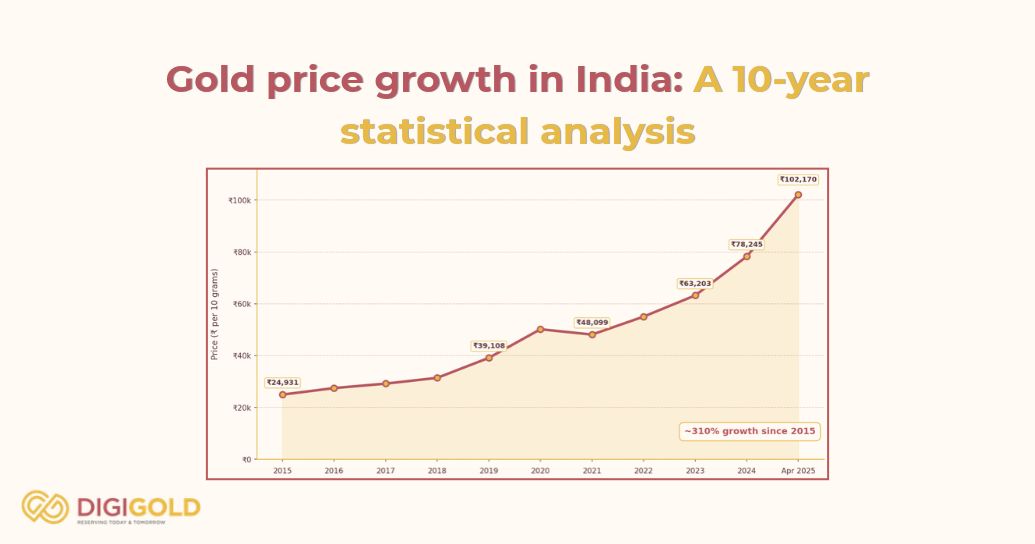
Gold that cost around ₹25,000 for 10 grams in 2015 was valued at nearly ₹78,000 in 2024, based on reported annual averages. By April 2025, the rate had crossed ₹1 lakh.
What could be the reasons for its rise? Was it due to inflation? Or uncertainty in the world? Or change in the behavior of investors? If you look at the numbers, you can get an idea what really happened.
Let's take a look at the Gold price trend over the last 10 years
The price of gold didn't rise at the same frequency every year. But ultimately, the prices moved upward.
Here's a snapshot of the average 24K gold rate in India over the years.
| Year | Gold Price per 10 Grams |
|---|---|
| 2015 | ₹24,931 |
| 2016 | ₹27,445 |
| 2017 | ₹29,156 |
| 2018 | ₹31,391 |
| 2019 | ₹39,108 |
| 2020 | ₹50,151 |
| 2021 | ₹48,099 |
| 2022 | ₹55,017 |
| 2023 | ₹63,203 |
| 2024 | ₹78,245 |
| April 2025 | ₹1,02,170 |
Source: Figures compiled by Forbes India and reported by The Indian Express.
Between 2015 and 2024, the average price rose by over three times. For anyone who has been tracking India's gold price history for a long time, that is a big change.
It's crucial to understand the gold price trend in India
The gold price trend in India shows that gold responds to uncertainty.
Take a look at the major phases of the last decade.
2015 to 2018
Gold prices experienced moderate movement during these years. Global economic concerns and currency changes influenced the market.
2019 to 2020
The COVID-19 pandemic resulted in huge uncertainty. Businesses slowed down, markets became volatile, and investors started looking for stability.
Gold benefited from this shift. Its price moved from approximately ₹39,108 in 2019 to ₹50,151 in 2020. The demand for gold as a safe-haven asset became visible.
2021 to 2022
After the sharp rise, prices experienced some cooling. Changes in interest rate, issues related to inflation, and geopolitical tensions played an important role in influencing the decisions of investors.
2023 to 2025
Economic uncertainty, purchases by the central bank, geopolitical tensions, and fluctuations in interest rates supported demand. By April 2025, the quoted 24K rate had crossed ₹1 lakh per 10 grams.
What's the reason behind rising gold prices?
Let's look at the biggest influences.
1. Inflation
When inflation rises, money gradually loses purchasing power. What you could buy for ₹5,000 then, now you need more money to buy it.
This is where the importance of gold rises. Investors believe that it is a hedge against inflation because its value has historically risen over longer periods. However, it's not a perfect hedge.
Even in cases where inflation is significant, prices may decline.
2. Global Gold Price movements and their impact on Indian Rupee
India is a major importer of gold. Because of this, foreign pricing is very important to domestic consumers.
Gold is generally traded globally in US dollars. When the rupee against the US dollar weakens, importing the same quantity can become more expensive.
As a result, domestic gold prices may rise even without an equally sharp increase in the global price. The ultimate price of gold in India is further influenced by local demand, import taxes, and GST.
3. Tensions in geopolitical boundaries and economic uncertainty
Financial crises, political unrest, trade disputes, and wars can all change investor behavior.
In times of uncertainty, investors look past volatile assets. They show interest in gold.
This interest in gold can increase demand. Additionally, the gold market reacts to increased demand by raising prices.
4. Changes in investment preferences
Gold is no longer limited to physical purchases. Indian investors look beyond physical gold investment.
There are options like gold ETFs, sovereign gold bonds, digital gold, and so on.
This wider access has changed how people approach gold.
Key takeaways from gold price history in India
One interesting observation is its long-term upward movement. Between 2015 and 2024, the nominal price increased from approximately ₹24,931 to ₹78,245 per 10 grams.
That's an increase of over 200%. The approximate compound annual growth rate over this period was 13.6%.
Gold prices can experience corrections. They can remain relatively flat for extended periods.
Someone purchasing at a market peak may have to wait before seeing positive returns.
A few observations are as follow:
- Gold has responded strongly to global uncertainty.
- Currency depreciation can increase domestic prices.
- Inflation has influenced investment interest.
- Short-term corrections haven't necessarily changed the longer-term direction.
- Different purchase periods can produce very different returns.
These observations on gold price fluctuations explain why historical prices should be studied across multiple years, rather than through isolated market highs.
Also, historical performance cannot predict future trends with certainty.
It's not necessary that a rising gold rate trend is a sign of good investment
It all depends on your financial goals and for how long you are going to invest. Investing in gold allows you to diversify your portfolio. But it is not wise to invest all your money in it.
Investors may find it easier to manage short-term price fluctuations and volatility with a longer holding time. However, returns aren't guaranteed, even over extended periods.
Gold can also serve different purposes. Some people buy it for jewellery. Some consider it as a financial reserve. Some use gold ETFs for market exposure. And so on.
It's crucial to understand why you're buying before deciding how much to buy.
Investors can think of digital gold as an option. They can buy in small amounts. They don't have to think about storing it physically.
Digital gold is a convenient way to invest in gold
If you want to own gold without buying jewellery, you can opt for digital gold.
It allows individuals to purchase gold online in small amounts. The value of the purchased quantity is measured in terms of prevailing gold price. Depending on the platform, the gold is backed by physical 24K gold held in secure vaults.
Whoever wants to start small, invest in digital gold.
Below are the reasons people explore this option:
- You don't need a large budget to begin.
- You can buy gold online without visiting a physical store.
- There are no personal storage worries.
- You can add to your holdings as your budget allows.
Platforms like DigiGold make it easier to explore digital gold purchases.
How to stay updated with the latest gold price trends in India?
Consider the following factors:
Look beyond one-year performance: Compare five-year and ten-year periods. A short rally may not reflect the broader market in India.
Understand the reason behind price changes: Follow inflation, interest rates, global growth, and currency movements. These economic factors often influence gold rates in India.
Compare investment options: Physical gold, gold ETFs, and digital gold have different costs and ownership structures. Choose based on your requirements.
Avoid reacting to every headline: A sudden fluctuation doesn't automatically mean it's the right time to buy gold.
Also, remember that jewellery purchases involve making charges. Investment-oriented purchases may have different costs. Even a small difference can affect your overall returns.
The best approach is to study market analysis alongside your own financial goals.
How will gold look over the next ten years?
What happened over the previous decade may not happen again in precisely the same way.
However, several factors will continue influencing demand for gold. Inflation, geopolitical tensions, central bank buying, currency movements, and changing economic conditions will remain relevant.
India's cultural relationship with gold also matters. Weddings, festivals, household savings, and investment demand continue supporting its place in the economy.
The rising gold prices seen in 2025 also brought renewed attention to its long-term potential.
Yet, investors should remember that an upward trend can include periods of correction.
Historical performance is useful for perspective, not as a promise of future returns.
Gold investment is not only confined to price
For Indian investors, understanding its history can help make more informed decisions.
Whether you're considering physical gold or digital alternatives, look beyond the latest price.
Study the market. Understand your investment horizon. And make choices that fit your financial plans.
After all, successful investing isn't about chasing every upward trend. Sometimes, it's about understanding what you're investing in and why.

Related Posts
- 25 Nov , 2026
- Kuldeep
Gold price growth in India: A 10-year statistical analysis
Explore gold price India 10 years of history, key price movements, market trends, and factors shaping gold's value over the decade.
- 12 Oct , 2026
- Kuldeep
Where to Buy 24K Digital Gold Online at the Lowest Price in India?
Searching for the Lowest Gold Price in India? Buy Gold Online with 24K purity, live pricing, insured storage, and flexible redemption.
- 13 May , 2026
- Kuldeep
How to Start Digital Gold Investment in India: Buy Digital Gold & Build Wealth with Gold SIPs
Learn how to start digital gold investment in India with ease. Discover how to buy digital gold, invest through Gold SIPs, build wealth, and enjoy secure, flexible gold ownership online.